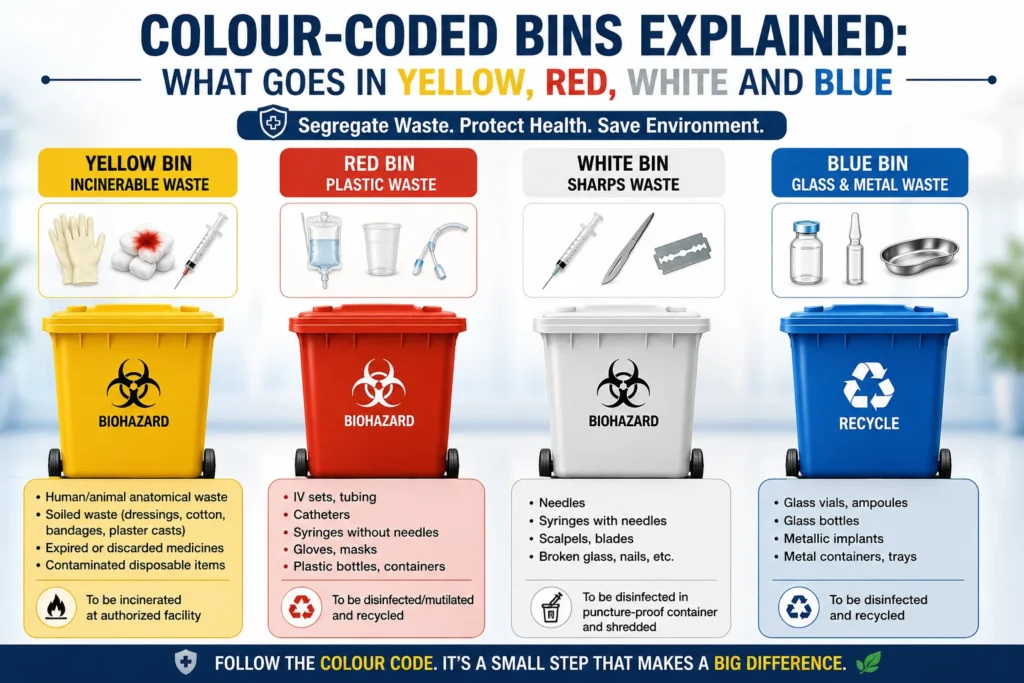
India’s Bio-Medical Waste Management Rules, 2016 replaced the earlier ten-category system with four colour-coded streams, each tied to a specific treatment method. Yellow goes for incineration. Red is autoclaved and recycled. White (translucent) holds sharps. Blue holds glassware and metal implants for disinfection and recycling. A fifth colour, black, is used for general waste but that falls under municipal solid waste rules, not biomedical waste rules.
The colour is not a filing convention. It is a treatment instruction. That is the single most useful thing to understand about the system.
Container: Yellow non-chlorinated plastic bags or containers.
What goes in:
| Sub-category | Examples |
| Human anatomical waste | Tissues, organs, body parts, placenta, foetus below the viability period under the MTP Act |
| Animal anatomical waste | Carcasses, organs and tissues from veterinary facilities, animal houses and research |
| Soiled waste | Dressings, cotton swabs, plaster casts, and any item contaminated with blood or body fluids |
| Expired or discarded medicines | All pharmaceutical waste, including cytotoxic drugs and any ampoule or vial contaminated with them |
| Chemical waste (solid) | Discarded disinfectants, chemicals used in producing biologicals |
| Chemical liquid waste | Silver X-ray developing solution, discarded formalin, aspirated body fluids, laboratory liquids, floor washings from disinfection |
| Soiled linen | Mattresses, bedding and linen contaminated with blood or body fluid; routine masks and gowns |
| Microbiology and laboratory waste | Blood bags, cultures, stocks and specimens of microorganisms, live or attenuated vaccines, cell cultures, culture dishes |
How it is treated: Incineration, plasma pyrolysis, or deep burial. Cytotoxic waste requires incineration at above 1200°C, or return to the manufacturer where such a route exists. Chemical liquid waste is pre-treated and discharged to an effluent treatment plant.
Two things people get wrong here. Blood bags belong in yellow, not red even though they are plastic because they are classified as microbiology and laboratory waste. And laboratory cultures and blood samples must be pre-treated by sterilisation or disinfection on-site, as per WHO and NACO guidance, before being handed to your treatment facility. Handing over untreated culture plates is a violation, not a courtesy.
Container: Red non-chlorinated plastic bags or containers.
What goes in: Contaminated recyclable waste from disposable items intravenous tubes and sets, catheters, urine bags, bottles, tubing, gloves, and syringes without needles (including fixed-needle syringes only once the needle has been cut).
How it is treated: Autoclaving, microwaving or hydroclaving, followed by shredding or mutilation. The treated plastic then goes to authorised recyclers, or for energy recovery, or into plastic-to-fuel or road-making applications.
Red waste must never go to landfill. This is a specific prohibition in the Rules and one that state boards check.
Note the boundary: if the item is plastic and the plastic itself is waste, it is red. If the item is plastic but is essentially a container of infectious material, a blood bag, a culture dish it is yellow.
Container: Puncture-proof, leak-proof, tamper-proof translucent containers. Not a bag. Not a repurposed saline bottle.
What goes in: Needles, syringes with fixed needles, needles from needle cutters or burners, scalpels, blades, and any other contaminated sharp object capable of causing a puncture or cut used, discarded or contaminated.
How it is treated: Autoclaving or dry-heat sterilisation, followed by shredding, mutilation, or encapsulation in a metal or concrete container. Final disposal goes to iron foundries holding a valid consent to operate, to a sanitary landfill, or to a designated concrete sharps pit.
Sharps cause the most serious occupational injuries in this entire system. A needlestick from a contaminated needle carries a real risk of Hepatitis B, Hepatitis C and HIV transmission, and the person exposed is almost never the clinician it is the housekeeping staff member who lifts the bag.
Never recap a needle. Never overfill a sharps container past three-quarters. Never decant one sharps container into another.
Container: Cardboard boxes with blue markings, or puncture-proof blue containers.
What goes in:
How it is treated: Disinfection washing with detergent followed by sodium hypochlorite treatment or autoclaving, microwaving or hydroclaving, then sent for recycling.
The exception that catches people: any vial or ampoule contaminated with a cytotoxic drug does not go in blue. It goes yellow, for high-temperature incineration. Oncology day-care units and chemotherapy preparation rooms need this drilled in, because the instinct to treat a glass vial as glassware is very strong.
Black bags are not part of Schedule I. They hold general, non-infectious municipal waste packaging, food waste, office paper, and uncontaminated outer wrapping.
We are including black in a biomedical waste article for one reason: the black bin is your cost-control tool. Roughly 75–85% of everything a hospital throws away is ordinary waste. If it is correctly diverted to black, you only pay to treat the genuinely hazardous fraction. If it is mixed into yellow or red, all of it becomes biomedical waste, all of it gets incinerated or autoclaved, and your bill scales accordingly.
Poor segregation is not just a compliance risk. It is a line item.
| Item | Bin |
| Used cotton, gauze, soiled dressing | Yellow |
| Placenta, amputated tissue | Yellow |
| Expired tablets, syrups, injectables | Yellow |
| Blood bag (used, expired or discarded) | Yellow |
| Culture plate, microbiology specimen | Yellow — pre-treated on site |
| Used mask and gown from patient care | Yellow |
| Silver X-ray developer, discarded formalin | Yellow (liquid chemical) |
| Cytotoxic drug vial | Yellow, cytotoxic symbol |
| IV set, tubing, catheter, urine bag | Red |
| Gloves | Red |
| Syringe barrel with needle removed | Red |
| Needle, blade, scalpel, lancet | White |
| Syringe with fixed needle attached | White |
| Broken medicine vial or ampoule | Blue |
| Metallic implant | Blue |
| Food waste, packaging, office paper | Black (general waste) |
1. Segregate at the point of generation. Not in the corridor, not at the collection point. The Rules require it at source, and there is no way to reconstruct a mixed bag afterwards.
2. Do not store untreated waste beyond 48 hours. Longer storage requires written permission from the prescribed authority.
3. Label every bag and container with the biohazard or cytotoxic symbol as specified in Schedule IV, along with the details required for transport.
4. Bags must be non-chlorinated. Chlorinated plastic bags and gloves were phased out under the 2018 amendment. If your supplier cannot confirm non-chlorinated, change supplier.
Nearly every facility we work with has all four bins in place. What separates a compliant facility from a non-compliant one is rarely the bins it is whether the right bin is within arm’s reach of the person generating the waste.
If the sharps container is at the nursing station and the injection is given at the bedside, the needle travels. Somewhere on that journey it gets recapped, dropped into a red bag, or set down on a trolley. Put the container at the bedside and the problem disappears.
The second gap is training. The Rules require training at induction and annually thereafter, and they require Hepatitis B and tetanus immunisation for staff handling this waste. Housekeeping teams turn over faster than clinical teams, which means a facility that trained everyone last year may have a substantially untrained handling workforce today.

Which colour bin is used for sharps?
White (translucent), in a puncture-proof, leak-proof, tamper-proof container. Sharps must never go into a plastic bag of any colour.
Do blood bags go in red or yellow?
Yellow. Blood bags are classified as microbiology and laboratory waste, not as recyclable contaminated plastic.
What colour bag is used for expired medicines?
Yellow, regardless of drug class. Cytotoxic drugs and anything contaminated with them also go in yellow, carry the cytotoxic hazard symbol, and require incineration above 1200°C.
Where do gloves go?
Red, provided they are non-chlorinated. Gloves visibly soaked with blood or body fluid should be treated as soiled waste and placed in yellow.
How long can biomedical waste be stored on site?
No more than 48 hours without written permission from the prescribed authority.
Is black a biomedical waste category?
No. Black is for general municipal waste and is governed by solid waste rules, not the BMW Rules. It is still worth using properly, because correct diversion of general waste materially reduces treatment cost.

Samved Bio Medical Waste operates as a common biomedical waste treatment facility serving hospitals, clinics, laboratories, blood banks and veterinary centres across Gujarat. If your team would benefit from an on-site segregation review or a staff training session, get in touch.